
Care for a Japanese kitchen knife by washing it by hand, drying it promptly, protecting its edge and sharpening it when cutting performance declines. The right sharpening method depends on the knife’s steel and edge geometry, not simply where it was made.
Daily care: wash, dry and put away
Use mild dish soap, warm water and a soft sponge. Keep the cutting edge directed away from your hand, rinse off food residue and dry the blade and handle with a clean cloth. Do not leave the knife soaking or hidden in a sink. Hand washing avoids the heat, detergent exposure and collisions that can occur in a dishwasher.
During preparation, remove acidic or salty residue promptly. Keep a damp cleaning cloth and a dry cloth nearby, especially when working with reactive carbon steel. Dry the knife before a break rather than leaving it wet on the board.
Stainless and carbon steel need different attention
| Blade construction | What to watch for | Practical care |
|---|---|---|
| Stainless steel | More corrosion-resistant, but prolonged moisture can still cause rust. | Clean and dry after use; avoid damp storage. |
| Carbon steel | Reacts more readily to moisture and acidic ingredients. | Wipe during preparation and dry promptly. |
| Stainless-clad carbon steel | The exposed carbon-steel edge still needs attention. | Follow the care requirements of the core steel. |
The words “high carbon” alone do not tell you whether a blade is stainless. Confirm the actual steel specification. Alloy composition, heat treatment and blade geometry all influence performance; no single steel label describes every knife.
Patina is different from active rust
A carbon-steel blade may develop a smooth grey or blue-grey patina during normal use. Orange or reddish corrosion needs attention. Patina does not make the blade rustproof. If corrosion is rough, spreading or pitted, ask for care or repair advice before using aggressive abrasives that may alter the finish.
For longer storage, some carbon-steel knives benefit from a very thin layer of oil specifically labelled suitable for food-contact knife care, such as food-safe mineral oil or an appropriate camellia oil. Follow the oil and knife instructions and clean the blade before food preparation.
Protect the edge before it becomes dull
Choose a knife-friendly wooden board or a suitable soft synthetic cutting board. Avoid glass, stone and metal cutting surfaces. Use controlled cuts; do not twist a thin blade inside hard food, pry with the tip or chop bones and frozen ingredients with an ordinary chef’s knife.
Move chopped food with a bench scraper instead of dragging the cutting edge sideways across the board. Store the clean, dry knife in a suitable guard, block, saya or secure holder where its edge cannot strike other utensils. Never seal a damp blade inside a sheath.
Honing and sharpening are not interchangeable
Honing describes edge maintenance between full sharpening sessions. Sharpening removes steel to rebuild the cutting edge. A rod will not repair a chip or replace sharpening when an edge is worn.
A honing rod’s suitability depends on the blade and the rod. Follow your knife maker’s guidance before using one, particularly on a thin, hard edge. For TCK-2, use the waterstone progression described below. Avoid assuming that a steel rod, pull-through sharpener or powered grinder is suitable for every Japanese blade.
Choose a stone for the condition of the edge
A medium stone around 1,000 grit is a practical starting point for routine sharpening of many undamaged kitchen knives. Coarse stones remove steel faster and are generally reserved for more substantial work. Finer stones refine an edge; they are not a shortcut for fixing a dull or damaged bevel.
Stone ranges and grit labels vary. You do not need to buy a full progression before learning to hold a steady angle. Major chips, a broken tip or a substantially changed blade profile are good reasons to consult an experienced sharpener.
Check the stone instructions before adding water. Some waterstones need soaking; splash-and-go stones only need their surface wetted. Do not soak every stone or use oil on a waterstone unless its manufacturer specifies it. Secure the stone on a non-slip holder and check that its working surface is flat.
TONMA TCK-2: recommended stones and sharpening angle
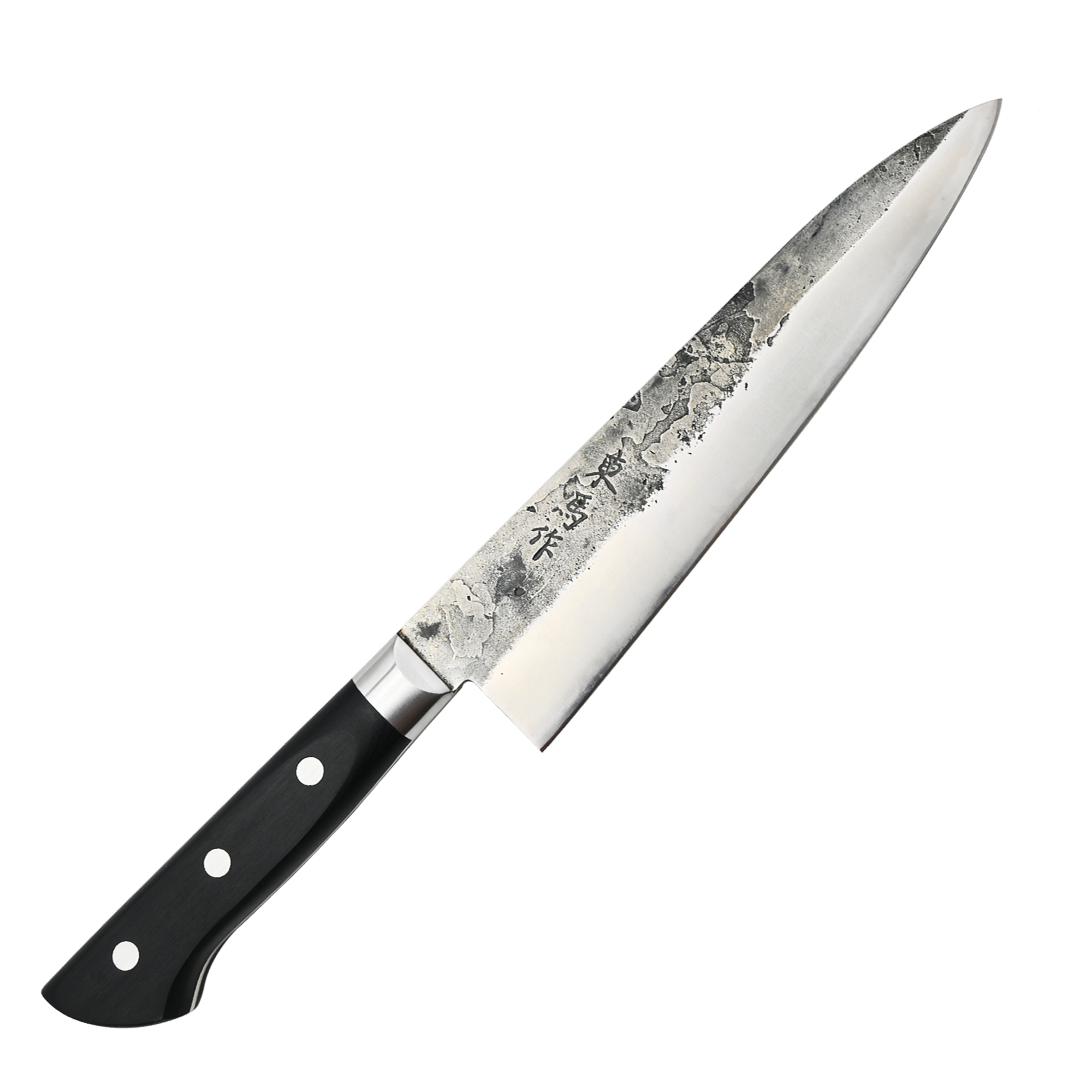
For the TONMA TCK-2 Gyuto, rated at HRC 61-62, TONMA recommends a Japanese waterstone such as King #1000 for regular sharpening and maintenance. After sharpening on #1000, follow with King #6000 when you want a finer, more polished edge.
- Knife
- TONMA TCK-2 Gyuto
- Hardness
- HRC 61-62
- Regular sharpening
- King #1000 waterstone
- Optional refinement
- King #6000 after #1000
- Sharpening angle
- Approximately 12-15 degrees per side
The #1000 and #6000 combination is TONMA’s recommended progression for maintaining this model. Use cutting performance to decide when sharpening is needed; polishing with #6000 is an additional finishing step. Keep the angle consistent, and prepare each stone according to its own instructions.
Model-specific information supplied by TONMA. These hardness, stone and angle recommendations apply to TCK-2; check the instructions for other knives.
How to sharpen a double-bevel Japanese kitchen knife
This overview is for undamaged, plain-edge, double-bevel kitchen knives. Single-bevel, serrated and asymmetric edges need different treatment. If you cannot identify the grind, check with the maker before starting.
- Inspect and prepare. Clean the blade, check for damage and prepare a flat stone according to its instructions. Work on a stable surface with adequate light.
- Match the existing bevel. Use the manufacturer’s recommended angle. Keep your wrist steady and your supporting fingers safely on the blade face, clear of the cutting edge.
- Work along the edge. Use controlled strokes with modest pressure, covering heel, middle and tip. Keep a waterstone’s surface wet as directed. Do not force the tip down or rock the blade.
- Check progress, then change sides. A small burr forms opposite the side being sharpened. Inspect under good light; never slide a finger along the edge. Preserve the knife’s original bevel balance.
- Deburr and refine. Reduce pressure and use light, alternating passes where appropriate for the grind. Refine on a finer stone if needed. A lingering wire edge can make a knife feel sharp briefly, then fail quickly.
- Wash, dry and check. Remove sharpening residue, dry the knife and test with a controlled cut on a stable board. Do not test sharpness against your skin.
What angle should you use?
For TONMA TCK-2, use approximately 12-15 degrees per side, or about 24-30 degrees total. Other knives may have different recommendations. About 15 degrees per side is a common reference for some double-bevel Japanese knives, not a universal specification. Preserve the original geometry and follow the maker’s instructions. An angle guide can help with consistency.
Japanese knife care: frequently asked questions
How often should I sharpen my kitchen knife?
Use cutting performance rather than a fixed calendar. Preparation volume, board material, edge geometry and technique all matter. If ordinary ingredients require increasing pressure or the edge repeatedly catches, assess whether maintenance, sharpening or repair is needed.
Can stainless Japanese knives rust?
Yes. Stainless steel resists corrosion; it is not immune. Wash off residue, dry promptly and avoid leaving the knife wet in a sink or sheath.
Do I need an 8,000-grit stone?
Not automatically. For TCK-2, TONMA recommends King #1000, followed by King #6000 if you want a finer finish. Higher grits are optional refinements for appropriate knives and tasks, not a requirement for every home cook.
Can I sharpen a single-bevel knife on both sides equally?
No. Its cutting face and back have different geometry. An equal-sided double-bevel routine can damage that geometry. Use instructions specific to the knife or an experienced sharpener.
Can I use this guide for a TONMA knife?
Use the daily-care principles alongside your model’s instructions. Confirm its steel, edge type and sharpening guidance first. For a model-specific question, contact TONMA with the model number and clear photographs.
Find the right knife, then care for its edge
Explore TONMA kitchen knives, including the TCK-2 chef’s knife shown above. Check each product’s specifications and choose a tool suited to what you actually cut.